



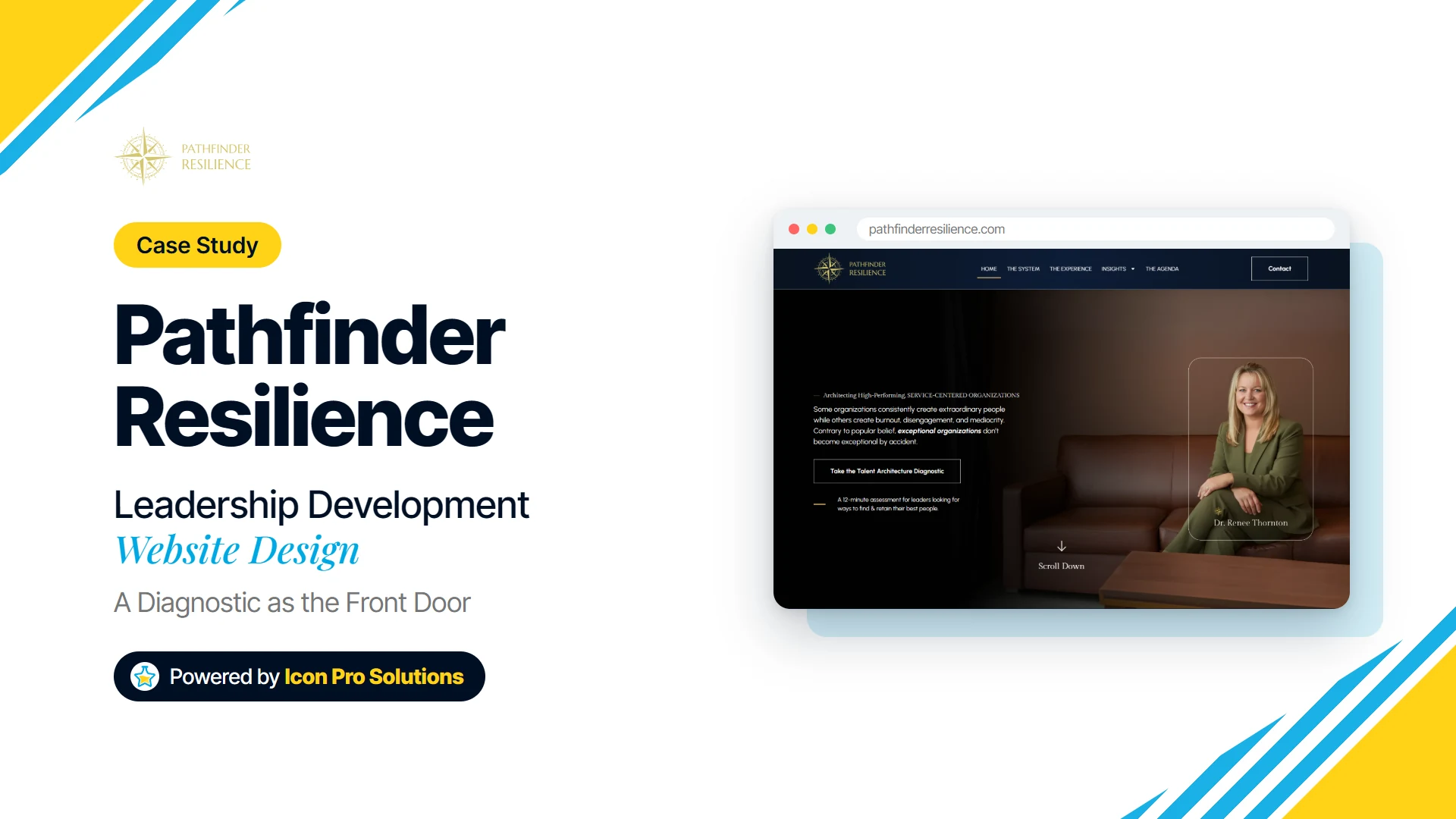
Pathfinder Resilience sells leadership development for mission-critical organizations, and its research collaborators come from public safety, emergency services and government. The hard part of a website for this kind of firm is the first step. A senior executive rarely books a sales call to find out whether they have a problem, and a contact form asks for commitment before it has given anything back.
The site we designed and built for Pathfinder Resilience answers that with a short diagnostic placed at the top of the home page. This case study looks at why that works as a front door for leadership development, what has to surround it for it to be taken seriously, and where the approach can go wrong.
Key Takeaways
- A short, clearly scoped self-assessment is a lower first step for an executive than a discovery call.
- State the time it takes, what it measures and what the person receives, before asking them to start.
- A diagnostic earns trust when the site first explains why the usual measures miss the problem.
- The assessment should be phase one of the paid method, not a quiz that stands apart from it.
- A named method needs a visible map, so buyers can see what follows the first step.
What Does Pathfinder Resilience Do?
Pathfinder Resilience describes itself as mission critical leadership development, built around architecting high-performing, service-centered organizations. Its method, The System, runs in four phases: Diagnose, Architect, Activate and Sustain. Its research collaborators come from emergency services, public safety and government leadership.
Around the method sits a set of experiences. The Summit gathers twelve executives for four days at Hotel Walloon on Walloon Lake, Michigan, twice a year. Honor the Temple is a body-mind-spirit practice led by Rodger Ruge, a law enforcement veteran of more than three decades and a California POST Master Instructor, while The Why Discovery is a one-on-one session, typically several hours long, led by Renee Thornton.
The site also carries books linked to Amazon, an app-based Navigating Adversity Program priced at $329 for one year of access, a newsletter, articles, and a calendar of recurring and dated events.
Why Offer a Diagnostic Before a Conversation?
Because it lets the executive get something before they give anything. The home page leads with one action, Take the Talent Architecture Diagnostic, described as a 12-minute assessment for leaders looking for ways to find and retain their best people. The visitor knows the cost in time and the question it will help answer before they click.
The System page then fills in the detail a careful reader wants. The diagnostic is twenty-four questions across six dimensions, completed by the executive making the decisions, and it produces a tier placement, a dimension-by-dimension breakdown and a clear signal of where the organization is doing its work and where it is not. That is the right order of information for a busy leader: how long, what it covers, and what comes back.
Why the Numbers Matter
Twelve minutes and twenty-four questions are small, concrete commitments. A vague invitation to take an assessment asks the reader to guess at the effort, and most will not bother. Specific numbers turn an unknown into a decision the reader can make in a few seconds.
What Makes a Diagnostic Credible Rather Than a Lead Magnet?
A self-assessment on a consultant’s site can easily read as a trick for collecting email addresses. What moves it past that is an argument for why it measures something the reader cannot already see. The Diagnose phase makes that argument directly: engagement surveys catch surface sentiment, performance reviews measure compliance with roles, and exit interviews come too late.
Only after naming what the standard tools miss does the page present the diagnostic as the replacement. Leaders in this audience have usually run surveys before, so the site has to explain why another instrument is worth their time. Without that argument, twelve minutes still feels like a lot.
Connected to the Paid Work
The second source of credibility is that the diagnostic is not a detached quiz. It is described as the entry point to the Diagnose phase, with a deeper Current State Assessment for organizations that engage further, and the page states that Diagnose is where most engagements begin. The reader can see that the free step and the paid work use the same framework, which makes the free step feel like a sample rather than bait.
Why Does a Named Method Need Its Own Map?
A leadership firm with a method, several experiences and a research program can easily bury all of it on one long page. The navigation here separates it into four groups. The System holds the phases, the diagnostic and the two leadership roles, The Experience holds the Summit, the Forging, Honor the Temple, The Why Discovery, Cohort Sessions and The Research, while Insights and The Agenda hold the publishing and the calendar.
That structure answers a buyer’s next question after the diagnostic: what happens if we continue? Each phase has its own short heading, and people are attached to parts of the method, with Rodger Ruge named as the practitioner behind the Activate phase’s body-mind-spirit work. A buyer can see who they would actually meet.
The Cost of Coined Language
The site uses its own vocabulary throughout: talent architecture, architectural data, state discipline. That language gives the method identity, but every coined term is a small tax on a new reader. The Honor the Temple section shows the remedy, following state discipline straight away with what participants learn: to recognize their own state and clear it deliberately.
What Keeps a Leadership Site Active Between Engagements?
Leadership work is sold slowly, so the site needs reasons for a leader to come back before they are ready to buy. The Agenda gives two recurring live sessions on Zoom: The Architecture Files every Monday, and Faith in Public Safety on the last Wednesday of each month. It also lists dated events in Pennsylvania, Walloon Lake, Edmonton and Hendricks County, Indiana.
The Insights articles open with a question and a one-sentence definition before the argument, such as what identity-driven leadership is. That format helps a reader skim, and it gives search engines and AI tools a clean answer to quote. The Products page adds a lower-priced entry point, the $329 app-based program, for readers who are not ready for a cohort or a retreat.
What We Would Watch
- Follow-through on the diagnostic. A result that arrives late, or reads as generic, undoes the trust the front door built, so the handover from assessment to report deserves as much care as the page itself.
- A calendar that ages. Dated events go stale the day after they happen, and a past date left on show tells visitors nobody is looking after the site.
- Formula fatigue. Question-and-definition openings help skimming, but across many articles the same opening shape can start to read as a template.
- Menu depth. A long footer navigation is thorough on a desktop and heavy on a phone, so the most important paths need to stay one tap away.
- Vocabulary drift. Coined terms need plain explanations on every page where a new reader might land, not only on the page that introduced them.
Frequently Asked Questions
Should a leadership consultancy put a self-assessment on its home page?
It can work well when the assessment is short, clearly scoped and tied to the paid method. State how long it takes, what it measures and what the person receives. If it is only a way to collect email addresses, readers in senior roles tend to notice.
How long should a leadership diagnostic be?
Short enough that the time can be stated up front and feels reasonable to a busy executive. Pathfinder states twelve minutes and twenty-four questions, which is a commitment most leaders can judge at a glance. Anything that needs a whole team to complete belongs in a later, deeper phase.
Do definition-first articles help a consulting site?
They help readers who skim and give search tools a clear answer to reference. The risk is sameness when every article opens the same way. Vary the structure after the opening definition so each piece still reads as its own argument.
See More of Our Work
Pathfinder Resilience is one of the leadership and consulting sites in our work. If your first step still asks visitors to book a call before they have learned anything, our UX and UI design service looks at what a better first step for your buyers could be.