



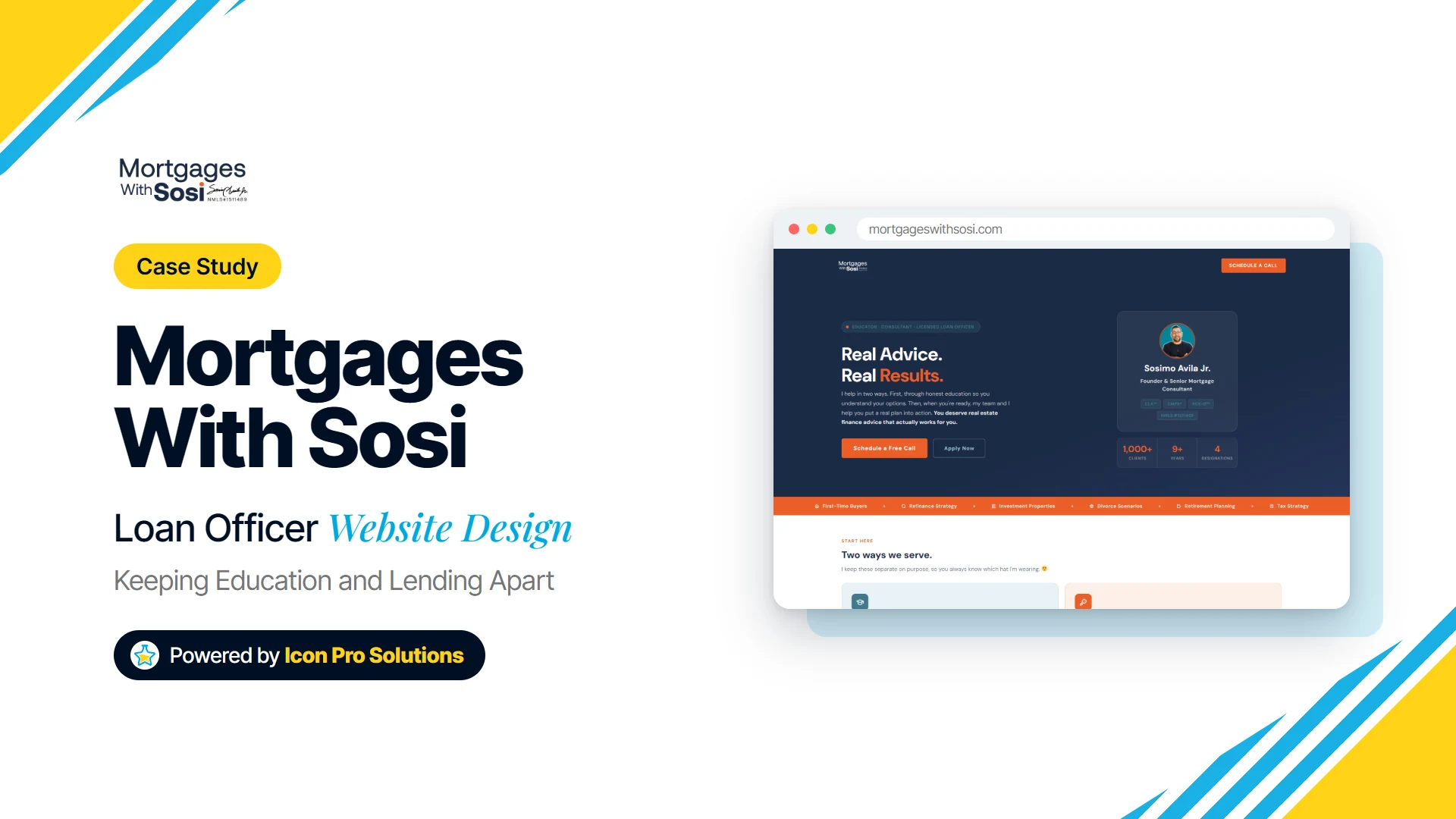
Mortgages With Sosi is the personal site of Sosimo Avila, a licensed loan officer who also teaches. That combination is common in lending and awkward on a website. A visitor reading a free market update needs to know it is education, and a visitor applying for a loan needs to know who is actually lending.
We designed and built the site. This post looks at how one page can carry two businesses without letting them blur, and what that separation asks of the owner afterwards.
Key Takeaways
- A loan officer who teaches is running two things, and the page should say so in plain words near the top.
- Labels on each section, not a disclaimer at the bottom alone, are what keep the two apart for a reader.
- Sorting visitors by where they are in a purchase is kinder than a single “apply” button.
- Credentials and license numbers belong beside the person’s name.
- The separation only holds if every future piece of content respects it.
What Does Mortgages With Sosi Do?
Mortgages With Sosi describes Sosi as “educator, consultant, licensed loan officer.” On the education side, Mortgages With Sosi LLC offers classes, content and consulting. On the lending side, loans are originated by Sosi through Mamba Capital Lending, where Mortgages With Sosi is the name of his loan team.
The page lists the situations he works on: first-time buyers, refinance strategy, investment properties, divorce scenarios, retirement planning and tax strategy.
Why Say Out Loud Which Hat Is On?
Because a reader cannot tell the difference between teaching and selling unless the page tells them. The home page has a section headed “Two ways we serve,” and its first line is “I keep these separate on purpose, so you always know which hat I’m wearing.”
Below it sit two blocks with their own labels. One is Free Education and Coaching under Mortgages With Sosi, described as “no sales pitch, just real information you can use.” The other is Real Loan Strategy with Mamba Capital Lending, which begins when the reader is ready for an actual loan.
The trade‑off
Splitting the offer in two means the page asks the visitor to choose before they do anything. That adds a step, and some visitors will not want to choose. The benefit is that nobody reads the market updates thinking they are receiving a loan offer, and nobody applies thinking they are signing up for a class.
How Does the Page Meet People Where They Are?
Instead of one “apply now” message, the lending section offers four starting points, each named after a situation. Prepare to Buy is for people who are not ready yet. Under Contract is for a second opinion on a deal already in progress.
Turn Bad Debt into Good Debt covers a cash-out refinance, and Catch Rates When They Move invites people onto a list for when rates change. Each card speaks to one moment in a borrowing decision, so a reader finds their own case without reading the rest.
The education side is sorted by audience in the same way: housing market updates, updates for realtors, and a report for homeowners.
The buttons follow the same logic. The hero pairs Schedule a Free Call with Apply Now, so a visitor who only wants to talk is not pushed into an application, and the contact block near the end opens with “No pressure, no sales pitch” before giving a cell number, an email address and a Book a Call button.
Why Put Credentials Next to the Name?
Because in lending the person is the product, and a reader wants to know who they are dealing with before they book a call. The hero names Sosi as Founder and Senior Mortgage Consultant, lists his designations (CLA, CMPS and RCS-D) and shows NMLS #1511489 in the same block.
The About section adds the background that explains the education-first approach: a civilian internship as a Navy Chaplain in college and more than five years running nonprofits before mortgages. The page also shows Sosi’s own figures of 1,000+ clients and 9+ years. Those describe his career, not anything the website has done.
Why Repeat the Split at the Bottom?
A labeled layout helps a reader, but the formal version still has to be written. The page ends with “A quick note on how this works,” which separates Mortgages With Sosi LLC, an education company whose content is not loan, tax or legal advice, from Mortgages With Sosi at Mamba Capital Lending, the licensed side.
It then prints both sets of numbers: Sosi’s NMLS and DRE numbers, and Mamba Capital Lending’s. A reader who wants to check can see exactly which person and which company holds which license.
What We Would Watch
- Content that drifts across the line. Every new class, video or update has to sit clearly on the education side or the lending side. A market update that ends in a hard loan pitch weakens the separation the whole page is built on.
- Two sets of license details. The disclosure depends on the brokerage’s numbers as well as Sosi’s own. If either changes, this page has to change the same day.
- Figures beside credentials. Any count shown next to badges invites a careful reader to check one against the other. The number and the badges should be updated together whenever either changes.
- Reviews. The page labels client reviews by loan type, which is useful context. Reviews in lending need care over what they imply about rates or results.
- No outcome figures. We have no numbers to report for this site.
Frequently Asked Questions
Can a loan officer run an education brand on the same site as their lending?
Yes, if the page labels each part clearly and the formal disclosure matches those labels. Mortgages With Sosi does it with two named sections and a closing note that separates the two companies.
Where should a loan officer put their NMLS number?
Beside their name, where a reader first meets them, and again in the disclosure. Putting it in both places answers the question when it is asked and when it is checked.
Is one page enough for a loan officer?
For a personal site that sorts visitors and hands lending to a brokerage, one well-structured page can be enough. It stops being enough once the education side grows into a library.
See More of Our Work
Mortgages With Sosi is one of several lending sites in our portfolio, each with a different problem to solve. If you are a loan officer who also teaches and needs a site that keeps the two clear, see our UX and UI design service.