


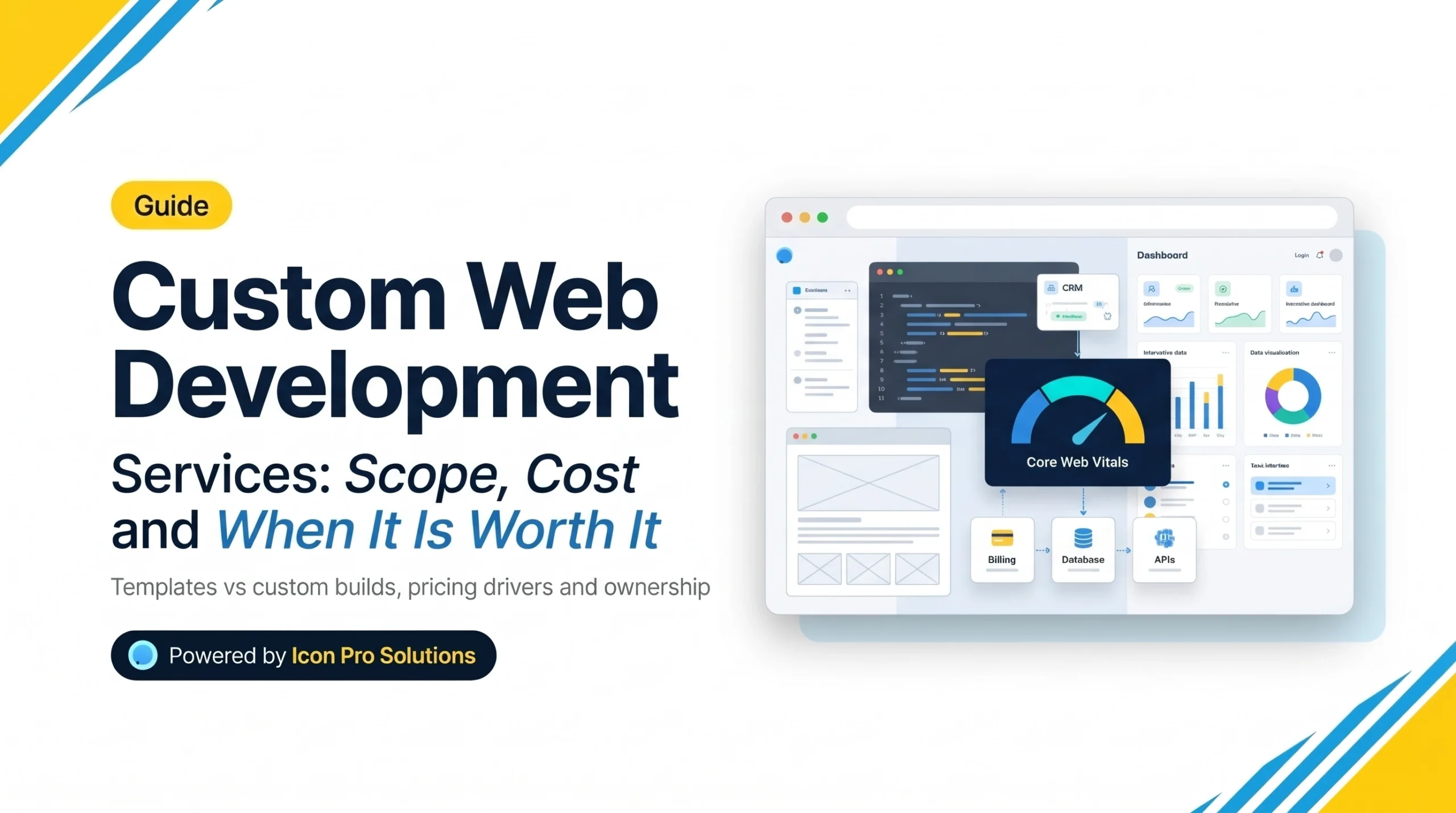
Custom web development services design and build a website or web platform around your specific requirements instead of adapting a ready-made template. They are worth paying for when a template or site builder cannot support your workflow, your integrations or your growth plans. For simple sites, they often are not.
This guide explains what a custom project includes and how it differs from a template or CMS. It also covers what drives the price and what you should own at the end. If you want checks to run on any agency before you sign, read our guide on how to choose a web design agency.
Key Takeaways: Custom Web Development Services at a Glance
- Custom means built to your brief. It does not always mean built from scratch.
- Many custom projects run on WordPress, which W3Techs found on 39.6% of all websites in October 2026.
- Price follows scope: features, integrations, design depth, content, accessibility and security.
- A sound scope names the pages or features, the content, the price and the timeline in writing before work starts.
- A good build meets current standards for accessibility, security and speed.
- At handover you should own the code, the domain, the hosting accounts and the design files.
What Do Custom Web Development Services Include?
A full project has six parts. Smaller jobs may skip some of them.
| Phase | What happens | What you receive |
|---|---|---|
| Discovery and scope | Goals, users and requirements are clarified | A written scope with pages or features, price and timeline |
| UX and UI design | Page structure and visual design are created | Approved designs for desktop, tablet and mobile |
| Front-end build | Designs become working pages | Responsive pages that match the approved designs |
| Back-end and CMS | Content, data and business rules are set up | An admin area your team can use |
| Integrations | The site connects to payments, a CRM or other tools | Working connections, tested end to end |
| Testing and launch | Browsers, devices and forms are checked | A live site and a launch checklist |
A custom build should also meet three public standards. Ask your developer how they will check each one.
- Accessibility. The W3C explains that WCAG documents “explain how to make web content more accessible to people with disabilities.” WCAG 2.2 was published in October 2023 and updated in December 2024.
- Security. The OWASP Top 10:2025 lists the most critical security risks to web applications. Ask which ones the project covers.
- Speed. Google’s Core Web Vitals set targets of 2.5 seconds for the main content, 200 milliseconds for responses and 0.1 for layout shift.
Is Custom Web Development Better Than a Template or Site Builder?
Not always. The right option depends on how far your needs sit from the standard.
| Option | Suited to | Main limit |
|---|---|---|
| Ready-made template | A fast, low-cost start | Looks like other sites and limits layout and workflows |
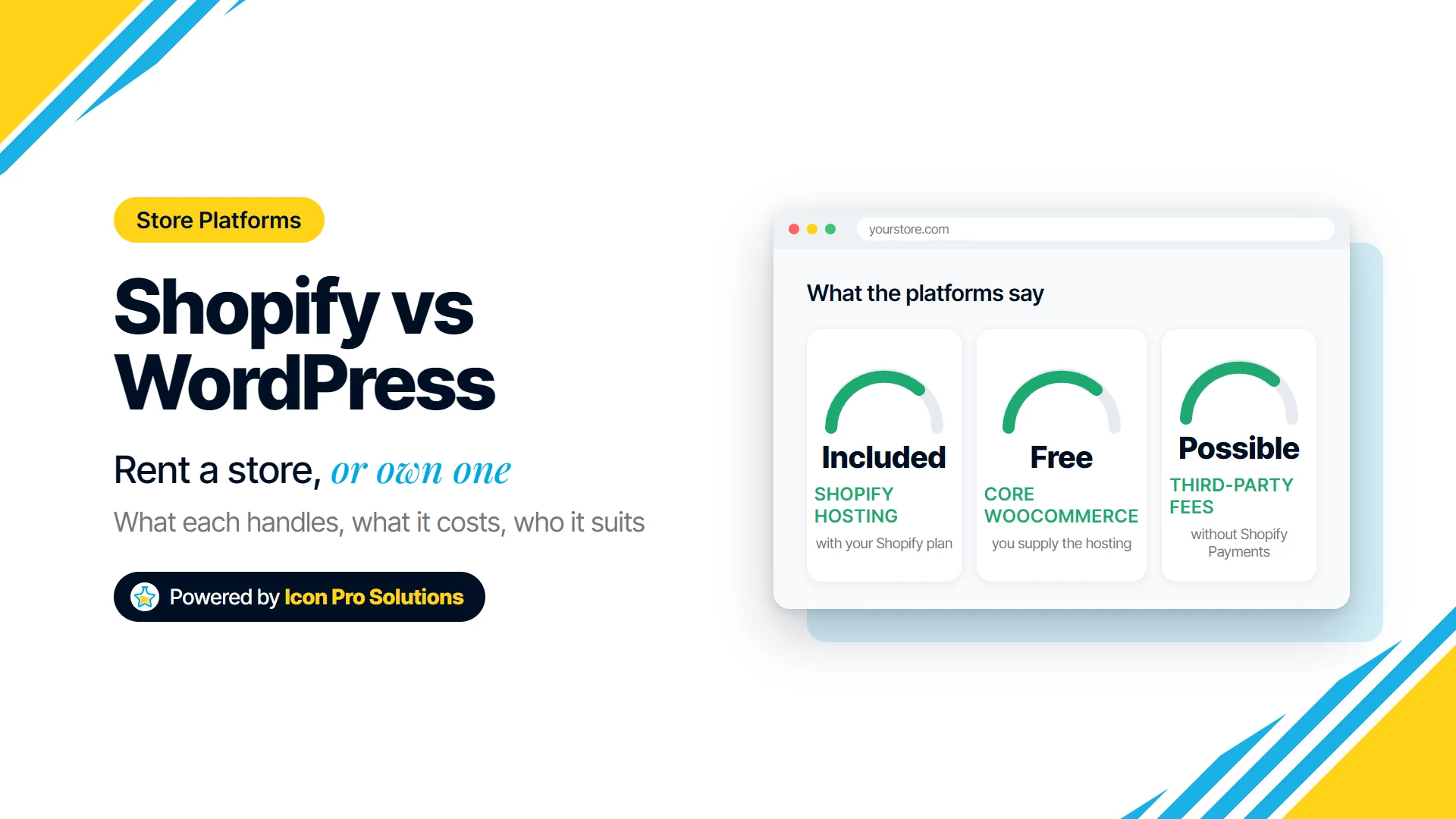
| Hosted site builder | Small sites that you edit yourself | Some builders keep the site on their own servers |
| Custom design on a CMS | Sites that need a unique design and easy editing | Needs a developer for new features |
| Fully custom build | Unusual workflows, roles or integrations | Highest cost, and it needs ongoing developer support |
Custom does not mean you must leave a CMS. A custom theme or plugin on WordPress is still custom web development. W3Techs reports WordPress on 39.6% of all websites as of 22 October 2026. Many custom projects use it because your team can edit pages without a developer.
When Are Custom Web Development Services Worth the Cost?
Custom work pays off when at least one of these is true:
- Your workflow does not fit any template, such as a custom quote tool or booking rules.
- The site must connect to your CRM, ERP, payment system or inventory.
- You have several user roles, each with different permissions.
- You expect traffic or content to grow well beyond a standard site.
- Your brand needs an interface that a template cannot give you.
However, it is usually not worth it when you need a five-page brochure site, when your requirements are still unclear, or when nobody will maintain the site after launch. In those cases, start with a template or a CMS site and add custom parts later.
What Drives the Cost of Custom Web Development Services?
Prices vary widely, so any quote without a written scope is a guess. Cost follows these drivers:
| Driver | It raises the cost when… | Ask your developer |
|---|---|---|
| Features | There are many unique tools or user roles | Which features are in the first release? |
| Integrations | Each outside system needs a connection | Which tools connect, and who maintains the connection? |
| Design depth | Every page needs a custom layout | How many unique layouts does the scope include? |
| Content | Pages must be written, migrated or translated | Who supplies the content, and by when? |
| Accessibility and security | The site handles accounts, payments or regulated data | Which standards will you test against? |
| Timeline | The deadline is short | What changes if we move the date? |
| Support | You want fixes and updates after launch | What is included after launch, and for how long? |
Ask for the scope in writing. It should list the pages or features, the content, the price and the timeline. If a vendor will not write these down, the project is not ready to start.
How Does a Custom Web Development Project Run?
A well-run project follows five steps:
- Understand. The team learns your goals, your audience and what you already have.
- Define. The team writes the scope and agrees it with you before work begins.
- Design. You approve the layouts before anything is built.
- Build and test. Developers build, then check browsers, devices and forms.
- Launch and support. The site goes live, and you agree who handles fixes.
Approval points matter most. First, you decide what is in the scope. Then you sign off on the design. Those two choices control most of the cost.
What Should You Own at the End of a Custom Project?
Agree on ownership before you sign. At handover you should hold:
- Source code and access to its repository.
- A domain registered in your name.
- Hosting and CDN accounts.
- Design files.
- All admin logins and a list of licenses and plugins.
- Written documentation of how the site is built.
Also ask for copyright in the finished work to transfer to you in writing. Without that, you may depend on the developer for every future change.
Need Custom Web Development Services?
If your project fits the signs above, we can scope it with you. We are a founder-led software house that builds websites, online stores and custom platforms. We scope the build in writing first, and the price comes from that scope.
Frequently Asked Questions
How long do custom web development services take?
It depends on the scope and on how fast you supply content and feedback. Ask for a timeline with dates for each phase inside the written scope. A clear timeline is a better sign than a promise to be fast.
Do custom websites rank better on Google?
Not automatically. Google says Search “always seeks to show the most relevant content, even if the page experience is sub-par.” A custom build gives you control over structure and speed. Your content and relevance still decide the ranking.
Can custom web development be done on WordPress?
Yes. A custom theme, custom plugins and a tailored admin area are all custom work. You keep the editing tools your team already knows.
Who maintains the site after launch?
You and your developer should agree on this before launch. Some teams offer a short fix window. Others offer a monthly plan for updates, backups and security checks.
Sources
- W3C Web Accessibility Initiative, Web Content Accessibility Guidelines (WCAG) Overview.
- OWASP, OWASP Top 10:2025.
- Google web.dev, Web Vitals, last updated October 2024.
- W3Techs, Usage statistics of content management systems, data as of 22 October 2026.
- Google Search Central, Understanding page experience in Google Search results, last updated September 2026.